What If You Could Spend Less and Sell More?
Understanding the nonlinear relationship between marketing budget and revenue, and how MMM-based reallocation delivers better results from the same investment.
Every year, marketing budgets grow. New digital channels are added, influencer marketing gets its own line item, and brand campaign budgets expand. Yet revenue growth doesn't keep pace with budget increases.
Does spending more actually drive more sales?
Many companies assume the answer is yes. If we spent $1M last year and generated $10M in revenue, spending $1.5M this year should yield $15M. But reality isn't that simple. The relationship between marketing budget and revenue is a curve, not a straight line.
This article covers:
- The structural reason budgets and revenue don't scale proportionally
- Three areas where inefficient spending hides
- How MMM-based budget optimization creates tangible results
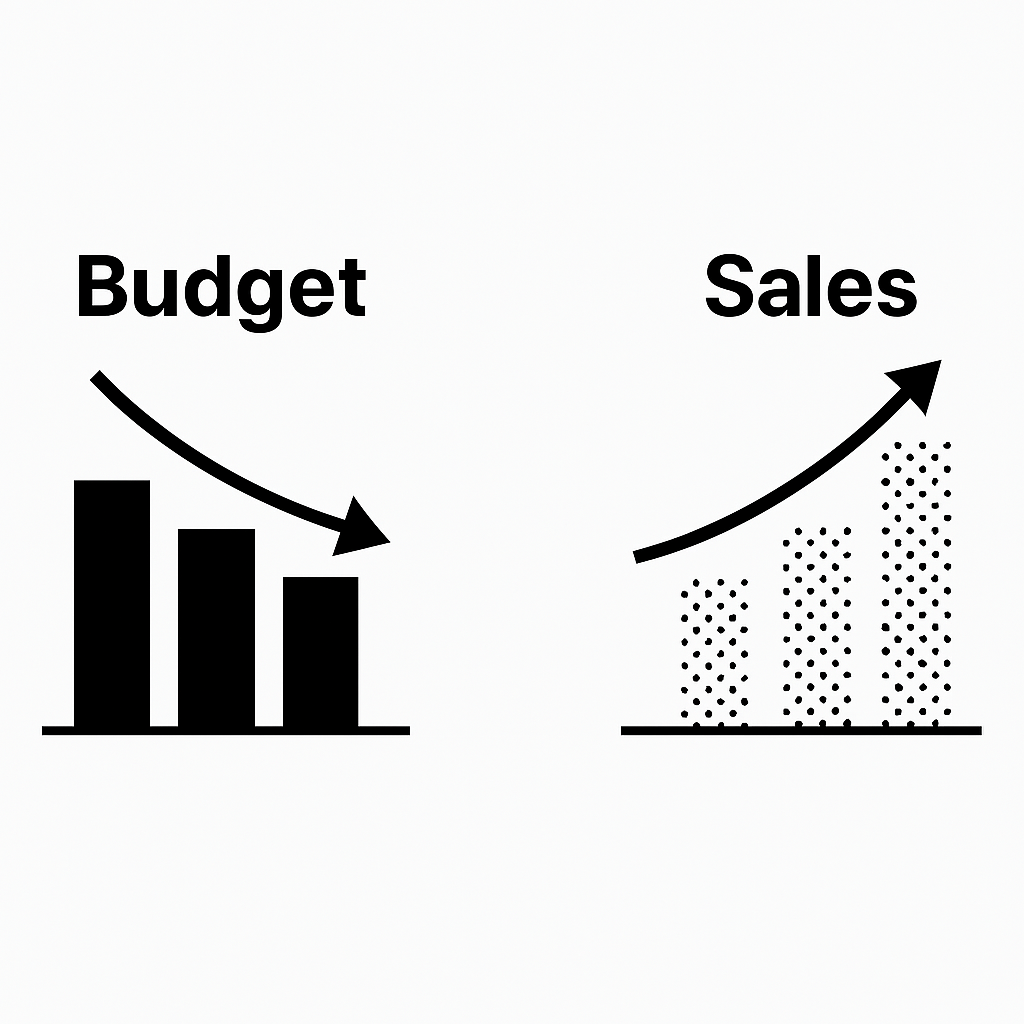
The Nonlinear Relationship Between Budget and Revenue
Marketing is subject to the law of diminishing returns. Initially, each dollar of spend generates significant incremental revenue. But as investment increases, the additional revenue produced by each marginal dollar shrinks progressively.
Consider TV advertising. Increasing weekly GRP (Gross Rating Points) from 0 to 200 drives a noticeable sales lift. But going from 200 to 400 delivers less than half the incremental gain. Beyond 400, there's minimal change—or even negative effects from consumer fatigue.
This phenomenon occurs across every marketing channel.
| Channel | Diminishing Returns Threshold | Primary Cause |
|---|---|---|
| **TV** | GRP 200–300+ | Reach saturation, repeated exposure |
| **Digital Display** | Frequency 5–7+ | Ad fatigue (banner blindness) |
| **Search Ads** | Top keyword share 80%+ | Intensified bidding, CPC spikes |
| **Promotions** | More than 2x per month | Discount expectation, full-price purchase decline |
The key insight: every channel has a boundary between "efficient investment" and "over-investment." Without knowing this boundary, a significant portion of additional budget becomes cost without incremental revenue.
Where Inefficient Spending Hides
The starting point for budget optimization isn't "how much more should we spend" but rather "where within our current budget is spending inefficient?" Inefficiency typically hides in three forms.
1. Channels Maintained by Inertia
"We did it last year, so we'll do it again"—the practice of carrying over last year's budget without performance measurement. Even as market conditions, consumer behavior, and competitive dynamics shift, channel mix and allocation remain unchanged.
Offline channels (TV, print, OOH) are especially prone to this, maintained on the assumption that "it's probably working" because performance measurement is more difficult compared to digital. Conversely, channels that are actually efficient but hard to measure may be systematically undervalued.
2. Seasonal Mismatch
Concentrating budget during high-demand seasons seems intuitively correct. However, high-demand periods are also high-Baseline periods. Concentrating spend in windows where sales would occur anyway means marketing's pure incremental effect may be relatively low.
Conversely, appropriate investment during off-peak seasons can generate high Incremental from a low Baseline. Temporal allocation (flighting) is as critical a variable as total budget.
3. Cross-Channel Overlap
Digital retargeting, email, and search ads frequently target the same customer simultaneously. Each channel reports the conversion as its own "contribution," but in reality, you may be paying three times for a single customer.
This overlap is invisible in channel-specific dashboards. It can only be discovered through integrated analysis within a unified model.
Before increasing budget, verify whether reallocating current spend could already improve performance.
MMM-Based Budget Optimization: Better Results from the Same Investment
Marketing Mix Modeling (MMM) estimates each channel's response curve based on historical data. This curve shows "how much revenue increases for a given investment in this channel" while simultaneously revealing where diminishing returns begin.
The Optimization Process
MMM-based budget optimization follows these steps:
- Channel-level ROI curve analysis – Model each channel's investment-to-revenue response as a nonlinear function
- Diminishing returns identification – Pinpoint where marginal ROI drops sharply
- Budget reallocation simulation – Test scenarios shifting budget from over-invested channels to those with remaining headroom
- Optimal allocation output – Calculate channel-level budget ratios that maximize revenue at the same total spend
Practical Scenario: Same Budget, Different Outcomes
| Scenario | Total Budget | Projected Revenue | Change |
|---|---|---|---|
| **Current Allocation** | $10M | $80M | Baseline |
| **Optimized Allocation A** | $10M | $88M | +10% revenue increase |
| **Optimized Allocation B** | $8.5M | $80M | Same revenue, 15% cost reduction |
Scenario A is a reallocation that increases revenue by 10% with the same budget. Budget is shifted from channels in the diminishing returns zone (e.g., TV) to channels with remaining headroom (e.g., digital, influencer).
Scenario B is a reallocation that maintains revenue while cutting budget by 15%. This is possible because trimming spend in low marginal-ROI zones has minimal impact on total sales.
Both scenarios follow the logic of "spend the same money better" rather than "spend more money."
Temporal Optimization: When to Spend
MMM enables not only cross-channel allocation but also temporal allocation optimization. By incorporating each channel's adstock (carryover effects) and seasonality patterns, it derives optimal monthly and weekly investment timing.
- Concentrate TV budget 2–3 weeks before peak season to maximize adstock carryover
- Maintain digital budget during off-peak for low-cost incremental gains
- Reduce promotion frequency while adjusting discount depth to protect margins
How much to spend, where to spend, and when to spend—optimizing all three simultaneously is the essence of MMM-based budget allocation.
It's Not About Spending More—It's About Spending Better
- Marketing budget and revenue have a nonlinear relationship, with diminishing returns present in every channel
- Inefficient spending hides in inertia-driven channel maintenance, seasonal mismatch, and cross-channel overlap
- MMM analyzes each channel's response curve and marginal ROI to identify over- and under-investment zones
- Budget reallocation alone can achieve 10%+ revenue growth at the same cost or maintain revenue with 15% cost savings
A more powerful report than requesting a budget increase is one that presents "specific methods to achieve higher performance with the same budget." Executives respond faster to efficiency gains than to cost increases.
If you need diminishing returns analysis and budget reallocation simulation across your marketing channels, MadMatics Action MMM is ready to help you get started.